
Azure vs AWS for Sydney Businesses: 2026 Comparison
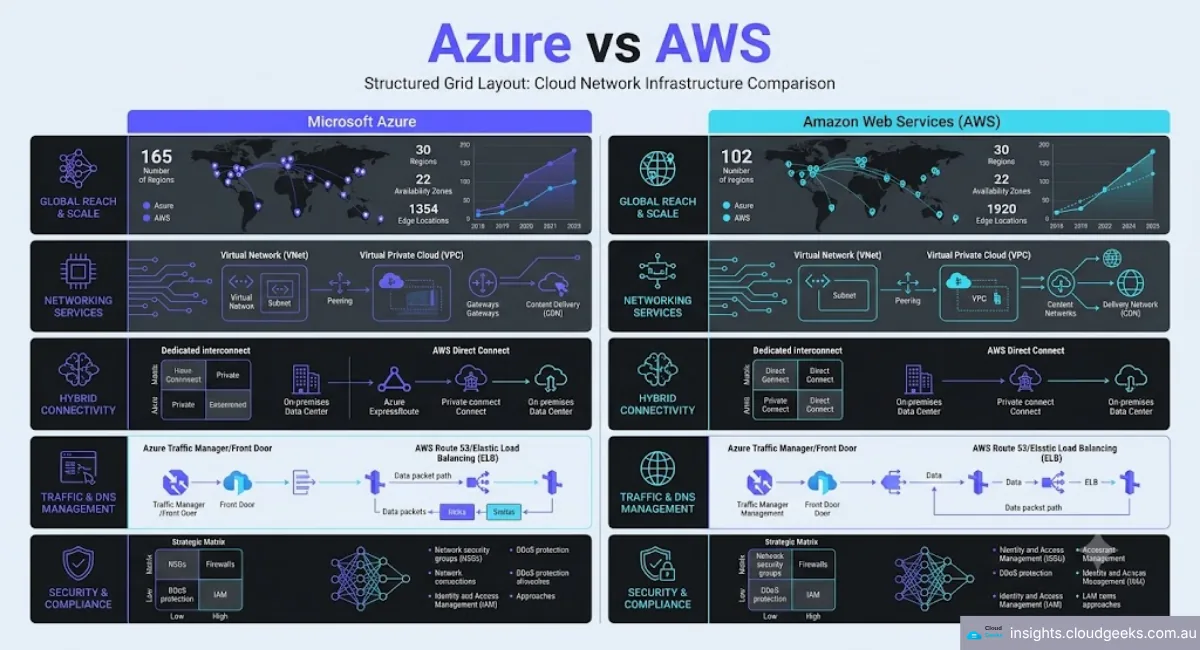
Azure vs AWS for Sydney Businesses: Updated 2026 Comparison
If you’re running a business in Sydney and it’s time to move your infrastructure to the cloud—or you’re re-evaluating an existing setup—the Azure vs AWS Sydney decision is probably keeping you up at night. Both platforms are excellent. Both have Australian data centres. Both will happily take your money. The question is: which one is actually right for your business?
After helping dozens of Sydney-based SMBs migrate to and optimise cloud infrastructure, we’ve seen this play out enough times to give you a straight answer—not a consultant’s “it depends.”
Why the Azure vs AWS Sydney Decision Matters More in 2026
A few years ago, you could almost flip a coin. But in 2026, the gap between what AWS and Azure actually offer Australian SMBs has widened in some important ways—pricing structures have shifted, Australian compliance requirements have tightened (particularly around data sovereignty under the Australian Privacy Act amendments), and AI-integrated services are now a core part of the decision, not an afterthought.
Getting this wrong means either overpaying for services you don’t need, or locking into an ecosystem that fights your existing tools every step of the way.
Australian Data Centre Footprint: Roughly Equal
Both providers have solid Australian coverage:
AWS Australian Regions
- ap-southeast-2 (Sydney) — primary region, launched 2012, three availability zones
- ap-southeast-4 (Melbourne) — launched 2023, three availability zones
Azure Australian Regions
- Australia East (Sydney/NSW) — primary, three availability zones
- Australia Southeast (Melbourne) — secondary, two availability zones
For most Sydney SMBs, this is a wash. Both offer sub-10ms latency within the Sydney metro area and both are certified for Australian data sovereignty requirements. If you have strict data residency requirements (healthcare, legal, government-adjacent work), confirm the specific service you need is available in-region—not every service from either provider is offered in the Australian regions.
Edge case: If you need Azure Government or AWS GovCloud equivalent for sensitive public sector work, speak to your account rep—these configurations require specific approvals.
Pricing in 2026: AWS Edges Ahead on Raw Compute
This is where things get interesting. Pricing for cloud services is notoriously opaque, but for the most common SMB workloads, here’s the honest picture:
Compute (VMs / EC2 vs Azure VMs)
For a comparable general-purpose instance—say, 4 vCPUs and 16 GB RAM running Linux:
- AWS EC2 (m7i.xlarge, Sydney on-demand):
$0.238 USD/hour ($0.37 AUD/hour) - Azure VM (D4s v5, Australia East on-demand):
$0.252 USD/hour ($0.39 AUD/hour)
AWS is marginally cheaper on raw compute, and their Reserved Instance program (1-year, no upfront) delivers around 30–35% savings. Azure’s equivalent (Reserved Instances + Azure Hybrid Benefit if you have existing Windows Server licences) can actually undercut AWS significantly for Windows workloads.
Key takeaway: If you’re running Windows Server workloads and have existing Microsoft licences through a Volume Licensing agreement or Microsoft 365 Business Premium, Azure Hybrid Benefit can save you 40–50% on Windows VM costs. For Linux workloads, AWS is typically 5–15% cheaper.
Storage Pricing
- AWS S3 (Sydney): $0.025 USD/GB/month for standard storage
- Azure Blob Storage (Australia East): $0.0208 USD/GB/month for LRS
Azure wins on storage pricing. For businesses with large media libraries, backups, or archival requirements, this difference compounds quickly.
Egress Costs
Data leaving the cloud—this is where both providers sting you. Both charge around $0.114 USD/GB for the first 10 TB/month out of Australian regions. This is one area where neither provider is your friend, and it’s worth factoring into your architecture decisions upfront.
The Microsoft Ecosystem Factor
This is the single biggest differentiator for most Sydney SMBs, and it gets undersold.
If your business runs Microsoft 365 (Teams, SharePoint, Exchange Online, Intune), Azure is a natural extension. The integrations are native:
- Entra ID (formerly Azure AD) connects directly to your Microsoft 365 tenant—single sign-on across cloud apps and on-premises systems without third-party middleware
- Microsoft Defender for Cloud integrates with Defender for Endpoint already on your endpoints
- Azure Virtual Desktop extends your Windows environment to remote workers without a separate VDI solution
- Power Platform (Power Automate, Power BI, Power Apps) connects to Azure data sources with point-and-click configuration
For a 20-person professional services firm in Parramatta already paying for Microsoft 365 Business Premium, adding Azure for cloud hosting, backup, or a SQL database is operationally seamless. Your IT manager isn’t learning a new identity system—they’re extending what they already know.
AWS’s answer to this—AWS IAM Identity Centre, WorkSpaces, and various third-party integrations—works, but requires more configuration effort and doesn’t benefit from Microsoft’s native integrations.
On the other hand: If your business is Google Workspace-first, or you’re a startup running entirely on Linux and open-source tools, this Microsoft advantage evaporates. AWS becomes the more natural fit.
Developer and DevOps Experience
For businesses with in-house developers or a managed services provider handling your infrastructure:
AWS Developer Advantages
- Broader service catalogue—AWS offers over 200 services versus Azure’s ~100 in the Australian regions
- More mature serverless ecosystem (Lambda, API Gateway, ECS/EKS)
- AWS CDK and CloudFormation have a larger community and more mature tooling
- Better support for multi-cloud and hybrid Linux environments
Azure Developer Advantages
- GitHub Actions integration (Microsoft acquired GitHub) is first-class for CI/CD pipelines
- Azure DevOps is a complete end-to-end platform for teams already in that ecosystem
- AKS (Azure Kubernetes Service) is consistently rated slightly simpler to operate than EKS for teams new to Kubernetes
- Visual Studio and .NET developers will find Azure tooling significantly smoother
If your team lives in GitHub and Visual Studio Code, Azure’s developer tooling is genuinely excellent. If your team uses a broader mix of tools or is more Linux-native, AWS’s ecosystem has fewer rough edges.
AI and Machine Learning Services in 2026
This is increasingly a deciding factor. Both platforms have matured their AI offerings significantly:
AWS AI Services
- Amazon Bedrock — access to foundation models including Anthropic’s Claude, Meta’s Llama, and AWS’s own Nova models
- SageMaker — end-to-end ML platform, strong for custom model training
- Q Business — enterprise AI assistant connected to your data
Azure AI Services
- Azure OpenAI Service — direct access to GPT-4o, o1, and other OpenAI models, with data residency in Australian regions
- Azure AI Studio — model hub and deployment platform
- Microsoft Copilot Studio — build custom AI copilots integrated with your Microsoft 365 data
For Sydney SMBs evaluating AI integration into existing workflows:
- If you want AI connected to your SharePoint, Teams, and email data, Azure OpenAI + Copilot Studio is the fastest path
- If you want to build custom AI applications or need model flexibility, AWS Bedrock offers more choice
- If you’re in regulated industries (healthcare, finance), both have compliance certifications, but check the specific service—not all AI services are certified for all compliance frameworks in Australian regions
Support and Local Ecosystem
Both AWS and Azure have strong partner networks in Sydney. For SMBs that need local support:
- AWS: AWS Partner Network includes a number of Sydney-based MSPs (managed service providers). AWS Business Support starts at $100 USD/month or 10% of monthly usage.
- Azure: Microsoft has a larger direct sales and support presence in Australia, and many IT firms in Sydney’s Hills District and Parramatta are Microsoft Gold Partners. Azure’s equivalent Business support tier is comparably priced.
For Hills District and Castle Hill businesses specifically—where we work with a lot of clients—the Microsoft partner ecosystem is notably denser. Finding a local Azure-certified partner for hands-on support tends to be slightly easier than finding an AWS specialist at the SMB level.
Azure vs AWS Sydney: The 2026 Verdict for Your Business
| Scenario | Recommendation |
|---|---|
| Already on Microsoft 365 | Azure — native integration, Hybrid Benefit savings |
| Windows Server workloads with existing licences | Azure — Hybrid Benefit makes it significantly cheaper |
| Linux/open-source stack, no Microsoft dependencies | AWS — broader service catalogue, competitive pricing |
| Startup with developer team | AWS or Azure (GitHub-first shops lean Azure) |
| AI-first strategy, OpenAI models | Azure — Azure OpenAI Service in Australian region |
| Large-scale data or ML workloads | AWS — SageMaker ecosystem is more mature |
| Needs local MSP support in Sydney | Azure — denser partner network locally |
| Multi-cloud or AWS already established | AWS — stay, optimise rather than migrate |
Next Steps for Sydney Businesses
- Audit your Microsoft dependency — if you’re on M365, calculate the Azure Hybrid Benefit savings with your current licence count before making any decision
- Run a cost comparison with real workloads — both AWS and Azure offer free cost calculators (AWS Pricing Calculator, Azure Pricing Calculator). Input your actual specs, not estimates
- Talk to a local MSP — a one-hour discovery call with a Sydney-based cloud partner can save you months of re-architecture later
- Don’t optimise for the wrong thing — the cheapest option on paper often isn’t cheapest in operation. Factor in management overhead, integration complexity, and support costs
At CloudGeeks, we help Sydney and Hills District businesses cut through the noise on cloud decisions like this. Whether you’re starting fresh or optimising an existing environment, the right answer is the one that fits your team, your tools, and your budget—not whoever ran the biggest marketing campaign this quarter.
Frequently Asked Questions: Azure vs AWS for Sydney Businesses
Is Azure or AWS cheaper for Sydney businesses in 2026?
It depends on your workload. AWS is typically 5–15% cheaper for Linux compute. Azure wins on storage pricing and becomes significantly cheaper for Windows Server workloads if you hold existing Microsoft licences—Azure Hybrid Benefit can cut Windows VM costs by 40–50%. Run both cost calculators with your actual specs before deciding.
Do AWS and Azure meet Australian data sovereignty requirements?
Yes. Both AWS (Sydney and Melbourne regions) and Azure (Australia East and Australia Southeast) are certified for Australian data sovereignty requirements and comply with the Australian Privacy Act. Always verify that the specific service you require is available in an Australian region, as not every service from either provider is offered locally.
Which cloud platform is better for small businesses in Sydney already using Microsoft 365?
Azure is the stronger choice for Microsoft 365 users. Entra ID provides native single sign-on across your M365 tenant, Microsoft Defender for Cloud integrates with existing endpoint protection, and Azure Hybrid Benefit reduces Windows Server licensing costs. The operational overhead of extending Azure into an existing M365 environment is significantly lower than adding AWS.
How do I choose between Azure and AWS if I’m starting fresh in Sydney?
Audit three things: your existing software stack (Microsoft 365 favours Azure; Google Workspace or Linux-first favours AWS), your team’s technical profile (GitHub and .NET developers lean Azure; broader DevOps teams often prefer AWS), and your AI strategy (Azure OpenAI Service for GPT-4o access in Australian regions; AWS Bedrock for multi-model flexibility). Run real workloads through both cost calculators before committing.
Ready to work out which cloud platform is right for your Sydney business? Contact CloudGeeks for a no-obligation infrastructure review.
Looking for a website that matches your enterprise-grade infrastructure? Cosmos Web Tech specialises in responsive web design and SEO for Australian businesses. Ashish Ganda is the founder of Ganda Tech Services, a Sydney-based technology consultancy helping Australian businesses grow through cloud, web, and mobile solutions.