
Digital Transformation Roadmap for Australian SMBs
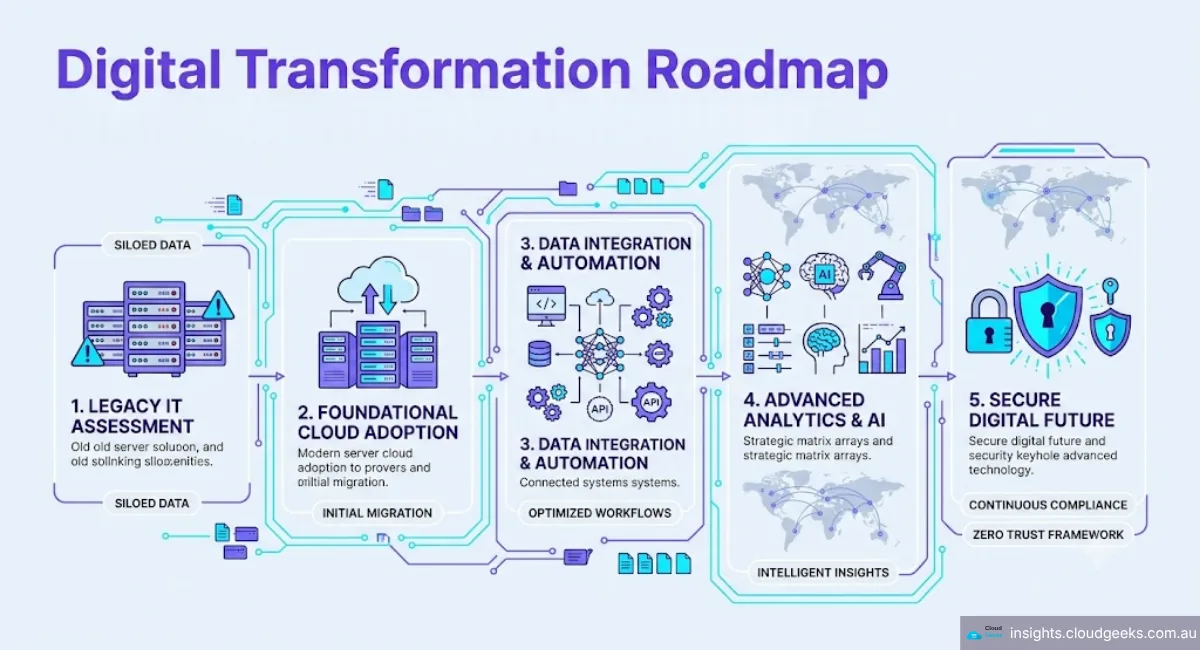
Digital Transformation Roadmap for Australian SMBs
You’ve heard the phrase “digital transformation” thrown around at every business conference and LinkedIn post for the past five years. And if you run a small or medium-sized business in Australia, you might be wondering whether it’s actually relevant to you — or just something that big corporates with million-dollar IT budgets get to worry about.
Here’s the truth: digital transformation is more critical for Australian SMBs than for enterprise businesses, not less. When your team is 10 or 30 people, the right technology can multiply your output by 2x or 3x without adding headcount. Done poorly, it drains budget and kills productivity. Done right, it’s the difference between scaling confidently and hitting a ceiling.
This roadmap gives you a practical, phased approach to digital transformation — built for businesses with real budget constraints, lean IT teams, and Australian compliance requirements.
What Digital Transformation Actually Means for Your Business
Before jumping into tools and timelines, let’s define what we’re actually talking about. For an Australian SMB, digital transformation isn’t about replacing every system overnight. It’s about three connected shifts:
- Moving from manual to automated — reducing repetitive admin so your team can focus on higher-value work
- Moving from on-premises to cloud — gaining flexibility, reducing infrastructure risk, and enabling remote work
- Moving from gut instinct to data-driven decisions — using business intelligence to guide strategy
A Hills District IT firm we work with recently made all three shifts over 18 months. They went from managing their own server room (with the associated headaches and hardware refresh costs) to a fully cloud-managed environment on Microsoft 365 and Azure. Their IT labour costs dropped by 30% and their team of six now manages 120 endpoints without breaking a sweat.
That’s transformation with an ROI you can measure.
Phase 1: Audit and Stabilise (Months 1–2)
Cost estimate: $0–$2,000 AUD (primarily your team’s time)
Before spending a dollar on new technology, you need a clear picture of where you stand. Most SMBs skip this step and end up paying for tools that overlap, contradict each other, or solve problems they don’t actually have.
What to audit
Applications inventory: List every piece of software your business uses and what it costs per month. Include the free tools — they have hidden costs in time and integration complexity. A typical 20-person SMB has 15–25 active SaaS subscriptions, many of which overlap.
Data flows: Where does customer data enter your business? How does it move between sales, operations, and finance? Manual handoffs (spreadsheets emailed between departments) are your biggest transformation opportunity.
Infrastructure health: Are you still running on-premises servers? When was the last hardware refresh? What’s your backup and disaster recovery posture? Many SMBs in Parramatta and Western Sydney are still running Windows Server 2012 — which has been end-of-life since 2023.
Team capability: Honest assessment of your team’s digital literacy. This shapes your rollout pace and training needs.
Output: Your Transformation Gap List
At the end of Phase 1, you should have a prioritised list of 5–10 gaps — specific things that are costing you money, time, or risk. Everything else in this roadmap flows from that list.
Phase 2: Modernise the Foundation (Months 3–6)
Cost estimate: $500–$3,000 AUD/month ongoing
With your gaps identified, the next phase is building the modern foundation that everything else will run on. For most Australian SMBs, this means three things.
Microsoft 365 or Google Workspace
If you’re still on on-premises Exchange or managing email through your hosting provider, migrating to Microsoft 365 Business Standard ($17.20 AUD/user/month) or Google Workspace Business Starter ($9 AUD/user/month) is your highest-ROI first move.
Beyond email, you get Teams or Meet for collaboration, SharePoint or Drive for file storage, and — critically — centralised identity management. That last part matters enormously for security: when a staff member leaves, you revoke one account instead of hunting down 12 different logins.
Migration typically takes 1–2 weeks for a 20-person business and can be managed without an enterprise IT team. We’ve done this for dozens of Hills District and Parramatta businesses with minimal disruption.
Cloud-based accounting and operations
If you’re on desktop MYOB or a locally-installed version of Xero, move to the cloud subscription. MYOB Business Lite is $27 AUD/month; Xero Starter is $35 AUD/month. The payoff: real-time financial visibility from anywhere, bank feeds that auto-reconcile, and payroll that stays compliant with STP Phase 2 requirements.
For operations, assess whether your CRM and project management tools have cloud equivalents. HubSpot’s free CRM handles most SMB needs. Asana, Monday.com, and ClickUp all have SMB-friendly plans under $15/user/month.
Endpoint management and security baseline
With staff working remotely or hybrid, you need centralised device management. Microsoft Intune (included in Microsoft 365 Business Premium at $28.10 AUD/user/month) lets you manage all your Windows and Mac devices from a single dashboard, enforce security policies, and remotely wipe lost devices.
Pair this with a reputable endpoint detection and response (EDR) solution. CrowdStrike Falcon Go starts at approximately $8 AUD/endpoint/month. This is not optional — the Australian Cyber Security Centre reported that 80% of cyber incidents could have been prevented by implementing the Essential Eight baseline controls.
Phase 3: Automate and Integrate (Months 6–12)
Cost estimate: $200–$1,500 AUD/month
Once your foundation is stable, you’re ready to eliminate the manual work that’s eating your team’s time. This is where transformation starts feeling real.
Identify your highest-cost manual processes
Focus on processes where:
- Data is re-entered more than once
- Staff spend more than 2 hours per week on a single task
- Errors regularly occur due to manual handling
Common candidates for Australian SMBs: quoting and invoice generation, lead follow-up sequences, onboarding new employees or clients, and monthly reporting.
Start with no-code automation
You don’t need a developer to automate these processes. Zapier and Make (formerly Integromat) connect your existing tools without writing a line of code.
A real example: a 15-person professional services firm in Castle Hill was manually copying lead data from their website contact form into their CRM, then sending a follow-up email, then creating a task in their project management tool. Three people. 45 minutes a day. We built a Zapier workflow that automated all three steps in four hours. Cost: $89 AUD/month for Zapier Professional. Annual saving: approximately $27,000 AUD in staff time.
Microsoft Power Automate for Microsoft 365 users
If you’re on Microsoft 365, Power Automate is already included. It handles document approvals, Teams notifications, SharePoint triggers, and Outlook rules — all without additional cost. It’s less flexible than Zapier for cross-platform workflows, but excellent for Microsoft-centric automation.
API integrations for growing complexity
As your automation needs grow, you’ll hit the limits of no-code tools. That’s when it’s time to bring in a managed service provider who can build lightweight API integrations between your core systems. A typical integration project for an SMB — connecting Xero to a CRM, for example — runs $3,000–$8,000 AUD as a one-off build, with minimal ongoing maintenance.
Phase 4: Intelligence and Optimisation (Months 12–18+)
Cost estimate: $300–$2,000 AUD/month
With a modern foundation and automated workflows in place, you’re ready to layer in business intelligence and AI tools that turn your data into competitive advantage.
Business intelligence: know your numbers in real time
Tools like Power BI (included in Microsoft 365 Business Premium) or Looker Studio (free from Google) connect to your cloud applications and build live dashboards. Sales pipeline health, project profitability, cash flow forecasting — these become available on demand instead of waiting for end-of-month reports.
A 25-person construction firm in Bella Vista we worked with built a Power BI dashboard connecting their job management software, Xero, and CRM. The owner now has a real-time view of margin by project type, which directly changed how they price new work. Estimated revenue impact in the first year: $180,000 AUD.
AI tools that are SMB-ready right now
The AI landscape moves fast, but these tools are mature enough for SMB adoption today:
- Microsoft Copilot (included in Microsoft 365 Business Premium): Drafts emails, summarises meeting recordings, generates first-draft documents. Saves 1–2 hours per person per week.
- GitHub Copilot ($19 AUD/user/month): If you have developers on staff, code completion pays for itself in the first hour.
- Fireflies.ai or Otter.ai ($15–20 AUD/user/month): Automatic meeting transcription and action item extraction. Eliminates manual note-taking.
Avoid the temptation to adopt AI tools before your data foundation is solid. AI amplifies what’s already there — clean data produces useful insights; messy data produces confident nonsense.
Common Pitfalls to Avoid
Transforming everything at once: Phased rollouts reduce risk and let staff adapt. A single major system change at a time is a good rule of thumb.
Underestimating change management: Technology is 30% of the challenge. Getting your team to use it consistently is the other 70%. Budget for training and allow 4–6 weeks for new tool adoption.
Skipping security: Every new cloud tool is a potential attack surface. Enforce multi-factor authentication (MFA) from day one. It takes 15 minutes to set up and blocks 99% of account compromise attacks.
Choosing tools by feature list: The best tool is the one your team will actually use. Involve staff in selection. Run 2-week trials before committing.
Your Next Step
Start with the audit. Block two days in the next fortnight, gather your team leads, and build your gap list. If you’d rather not do it alone, Cloud Geeks offers a Digital Readiness Assessment for Australian SMBs — a structured half-day session that produces a prioritised transformation plan with cost estimates and a 12-month roadmap.
Digital transformation isn’t a project with an end date. It’s an ongoing capability you build — and every phase compounds the one before it. The businesses in Sydney and across Australia that are pulling ahead of their competitors right now started their roadmap 12–18 months ago.
The best time to start was last year. The second-best time is today.
Ready to build your transformation roadmap? Contact Cloud Geeks for a complimentary Digital Readiness Assessment for your Sydney or Hills District business.
Considering an online store backed by your cloud infrastructure? Cosmos Web Tech creates Shopify and WooCommerce stores optimised for the Australian market. Cloud Geeks is the IT infrastructure division of Ganda Tech Services, providing managed cloud and cybersecurity solutions to Australian businesses.